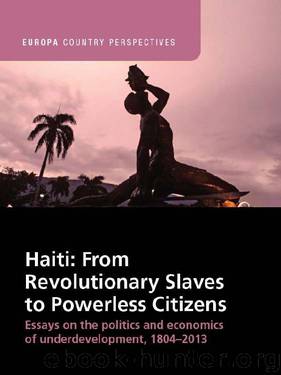
Haiti: From Revolutionary Slaves to Powerless Citizens: Essays on the Politics and Economics of Underdevelopment, 1804-2013 (Europa Country Perspectives) by Alex Dupuy
Author:Alex Dupuy [Dupuy, Alex]
Language: eng
Format: epub
ISBN: 9781317930990
Publisher: Taylor and Francis
Published: 2014-03-05T08:00:00+00:00
Duvalierism and black nationalism
Since the reunification of Haiti in 1818, a balance of power or “pact of domination” had been formed between the mulatto and black factions of the dominant class, with the former retaining its advantages in the economy and the latter tending to predominate in controlling the state and in land ownership. The US occupation from 1915 to 1934, however, would change that precarious balance of power in favor of the mulattoes, a fact that set into motion important new processes that would ultimately set the stage for the rise of François Duvalier to power in 1957 as the purported champion of the black-nationalist cause.
During the 1930s and 1940s there emerged two currents within the broad Indigéniste movement of that period. Linked internationally to the Négritude movement, the Indigénistes in Haiti criticized and rejected the racist claims of Western culture and the re-articulation of those beliefs in Haiti by the bourgeoisie (both mulatto and black) which valued European and especially French culture and language as a mark of its social superiority. By contrast, the Indigénistes promoted a “genuine” Haitian culture that recognized and validated its African roots and contents. An explicitly racist offshoot of the Indigéniste movement, known as the Griots (of which François Duvalier was a founding member), also emerged and went further by claiming that there existed a specifically African psychology and culture that was biologically determined and present in the collective personality of the predominantly black Haitian population. Accordingly, and in a formulation similar to that of Louis-Joseph Janvier referred to earlier, the solution to Haiti’s ills, which the Griots attributed to the mulatto elite’s European cultural values and support for the American occupation, consisted of transferring political power to the “authentic” representatives of the black majority and reorganizing the institutions of the society to express the African cultural values of the masses. Thus, the differences between mulattoes and blacks were said to stem principally from their cultural differences determined by their biological (i.e., color) characteristics rather than from their divergent class or economic positions. Moreover, contrary to those in Haiti who advocated a democratic form of government, the Griots nationalists maintained that Haiti needed a black leader who embodied the aspirations of the black masses and would defend them.
This more explicitly anti-mulatto articulation of the Griots nationalists served as the rallying cry for those sectors of the black middle class and bourgeoisie who opposed the economic and especially political resurgence of the mulatto bourgeoisie during and after the US occupation. That movement succeeded in bringing Dumarsais Éstimé to power in 1946 with the aim of shifting power back to the black elite and middle class. The so-called Estimist Revolution of 1946 was short-lived, however, as mulattoes seemed to gain the upper hand once again with the rise to power of Colonel Paul Magloire in 1950. Though not a member of the mulatto faction, Magloire none the less was allied with and served its interests. As a member of the Griots group and supporter of
Download
This site does not store any files on its server. We only index and link to content provided by other sites. Please contact the content providers to delete copyright contents if any and email us, we'll remove relevant links or contents immediately.
| Anthropology | Archaeology |
| Philosophy | Politics & Government |
| Social Sciences | Sociology |
| Women's Studies |
The Secret History by Donna Tartt(19477)
The Social Justice Warrior Handbook by Lisa De Pasquale(12297)
Thirteen Reasons Why by Jay Asher(9132)
This Is How You Lose Her by Junot Diaz(7060)
Weapons of Math Destruction by Cathy O'Neil(6483)
Zero to One by Peter Thiel(5953)
Beartown by Fredrik Backman(5951)
The Myth of the Strong Leader by Archie Brown(5631)
The Fire Next Time by James Baldwin(5592)
How Democracies Die by Steven Levitsky & Daniel Ziblatt(5333)
Promise Me, Dad by Joe Biden(5238)
Stone's Rules by Roger Stone(5196)
A Higher Loyalty: Truth, Lies, and Leadership by James Comey(5092)
100 Deadly Skills by Clint Emerson(5032)
Rise and Kill First by Ronen Bergman(4907)
Secrecy World by Jake Bernstein(4892)
The David Icke Guide to the Global Conspiracy (and how to end it) by David Icke(4854)
The Doomsday Machine by Daniel Ellsberg(4627)
The Farm by Tom Rob Smith(4614)
